For
decades, scientists have assumed that learning, memory, and
decision-making require a brain. However, growing evidence, including a
recent study published in Cognitive Science, challenges that idea and
suggests that complex information processing may not depend on neurons.
The
study, led by William & Mary psychology professor Peter Vishton and
his former student Paige Bartosh, suggests that plants may be able to
count. Not in the human sense, but Mimosa pudica appear to be able to
“keep track of the number of events in their environment,” said Vishton.
According
to the researchers, this is the first evidence that plants can
enumerate, meaning they can distinguish and track separate events.
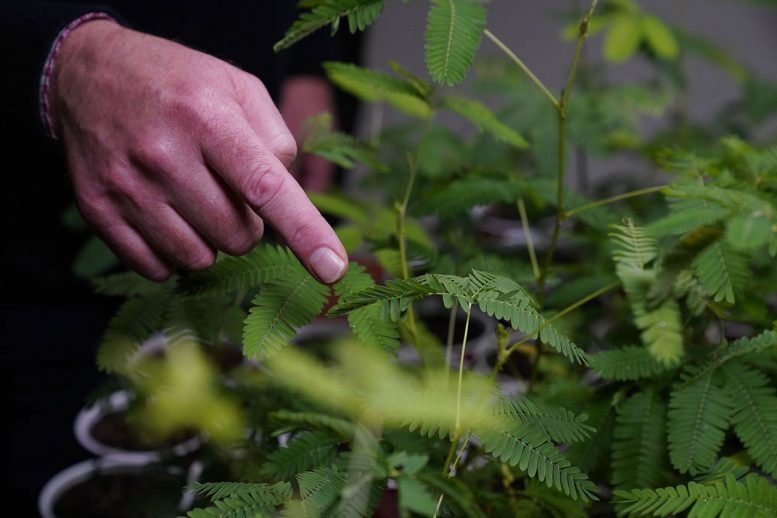
Mimosa
pudica, often called the shy plant or touch-me-not, has delicate,
frond-like leaves that fold inward when touched or shaken. The leaves
also close at night and reopen with daylight, a movement known as
nyctinasty.Experimental Setup and Plant Behavior Observations
In
a humid tent inside a windowless room at William & Mary’s
Integrated Science Center, the researchers exposed the plants to
repeating cycles of light and darkness and monitored their responses.
“In
the first phase of our experiment, we used a 24-hour cycle. On days one
and two, the plants were exposed to 12 hours of darkness and 12 hours
of light. On day three, the lights remained off,” Vishton explained.
After
about five repetitions, the plants began showing increased movement
during the “pre-dawn” period on days when light was expected, but not on
the third day when darkness continued.
Evidence of Learning and Pattern Recognition
“This
seems to suggest that the plants were able to ‘learn,’ for lack of a
better word, this three-day cycle and shift their movement in response,”
said Vishton.
Modeling
this shift yielded a logarithmic curve, meaning the plants’ movement
changed rapidly at first before gradually stabilizing into a consistent
pattern.
“This
is the same pattern we see all the time in animal learning,” said
Vishton. “For example, if you are teaching a rat to perform a series of
actions in a certain order, you would expect to see a period of time
when they’re figuring out the sequence and then a gradual increase in
their ability to predict the pattern.”
Time Tracking vs Event Counting Hypothesis
To rule out another explanation, the team tested whether the plants were tracking time instead of counting events.
“It’s
well established that many plants move in alignment with a 24-hour
circadian rhythm, opening up in anticipation of the sun,” said Vishton.
“While no evidence suggests plants can track a 72-hour cycle — the
duration of the three-day pattern in our study — we wanted to test that
possibility.”
When
the researchers shortened the daily cycle from 24 hours to 20 hours,
the plants quickly adjusted their movement to match the new pattern. To
further test their hypothesis, they ran a final experiment in which each
three-day cycle varied randomly, ranging from 10 hours (five hours of
light and five of dark) to 32 hours.
Testing Limits of Plant Memory and Patterns
They
found that the pattern broke down when the cycles were shorter than 12
hours or longer than 24 hours. This suggests there may be both a minimum
time needed for plants to process light and dark signals and a limit to
how long they can retain that information.Within the 12-24 hour range,
however, the plants consistently showed more movement on days when light
was expected compared to days of continued darkness.
“The
simplest explanation for this result is that these plants are tracking
the number of events that take place,” said Vishton. “Not simply
responding to time.”
Implications for Non-Neuronal Intelligence
If confirmed by future studies, these findings point to a form of information processing that does not rely on neurons.
“Every
theory I’ve ever read on memory and decision making always involves
neurons,” said Vishton. “Big surprise, plants don’t have those. And yet
it looks like they can perform cognitive-like functions. Just not
cognitively, per se.”
The results raise the possibility that other non-neuronal cells may also be capable of learning.
“There
are lots of cells in animals and humans that aren’t neurons. And we
just assume they’re not involved in learning,” said Vishton. “But maybe
they could be. Maybe learning is present in every cell. We’ve just never
really studied it before.”
Future Research and Broader Impact
How this type of intelligence works at a biological level remains unclear and will require further research.
“As
a developmental psychologist, I’m interested in characterizing
behavior,” said Vishton. “I’m hoping the chemists and biologists of this
world can ask more mechanistic questions to understand how this is
actually happening. With more research on both fronts, I’m very excited
to see where this field of study is headed.”
Potential
applications could include biological computing systems, plant-based
sensors, and even approaches to help people “unlearn” addictive
behaviors at the cellular level.