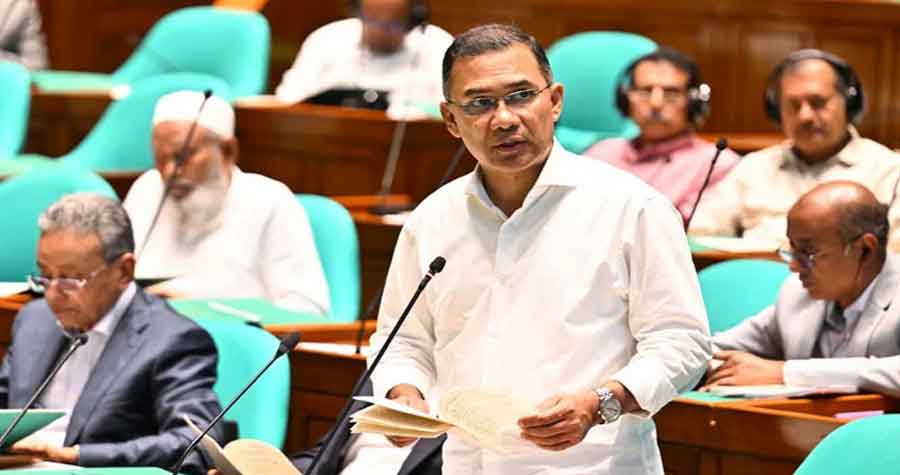
Prime Minister Tarique Rahman today said the government is taking necessary measures based on the ‘White Paper’ prepared by the interim government on corruption over the past 17 years.
“The interim government had formed a committee, and that committee published a White Paper or a report on various issues, particularly on the economy. If we look at it, we get a clear picture of what happened during that period,” he said while replying to a supplementary question from lawmaker Mobasher Alam Bhuiyan in the parliament this afternoon.
The Prime Minister said the government is examining the findings of the White Paper and gradually taking necessary measures based on it.
Replying to another question on delays in project implementation and increases in project costs, he said such problems were not caused by any single factor but resulted from a number of interconnected weaknesses in project formulation, approval, land acquisition, financing, procurement and management.
He said weak feasibility studies, inaccurate cost estimates and inappropriate selection of project areas often create problems from the outset. Delays in land acquisition and relocation of utility services, procurement-related complications and failure to appoint project directors on time also contribute to implementation delays, he added.
Weak monitoring and accountability, mismatches between financing plans and budget allocations, and inadequate coordination among ministries and agencies are also responsible for delays and cost escalation, he said.
The Prime Minister said the government has taken a number of measures to address these problems. Feasibility studies will be made more accurate before taking up new projects, while preparations for implementation will be expedited after project approval, he said, adding that guidelines for project formulation, processing, approval and revision are also being updated.
Dashboards are being introduced in ministries and divisions to monitor project implementation, while regular reviews and field-level supervision are being strengthened, he said.
He said coordination over land acquisition and relocation of utility services would also be strengthened. Delayed projects will be reviewed to identify the causes of delays, irregularities, cost escalation and repeated revisions, and action will be taken under the existing rules against the persons or institutions responsible, he said.
For projects with implementation progress below 30 percent, the concerned ministries and divisions will consider restructuring, changing the scope or continuing the projects based on their utility and effectiveness, he said.
The Prime Minister also stressed the need to avoid taking up isolated projects and instead implement cluster-based projects under integrated programmes. He said the government would expand the use of the e-GP system and appoint project directors based on professional qualifications, skills and practical experience, while ensuring continuity in cases where it is necessary for successful implementation.
He said the government is also updating relevant policies and encouraging public-private partnerships. An initiative has been taken to update the Public Procurement Rules 2025 to make the procurement process more competitive and accountable.
Ajkaler Khobor/MK